

Baby Botox for Oily Skin, Enlarged Pores and Redness: What Can Micro-Botox Really Do?
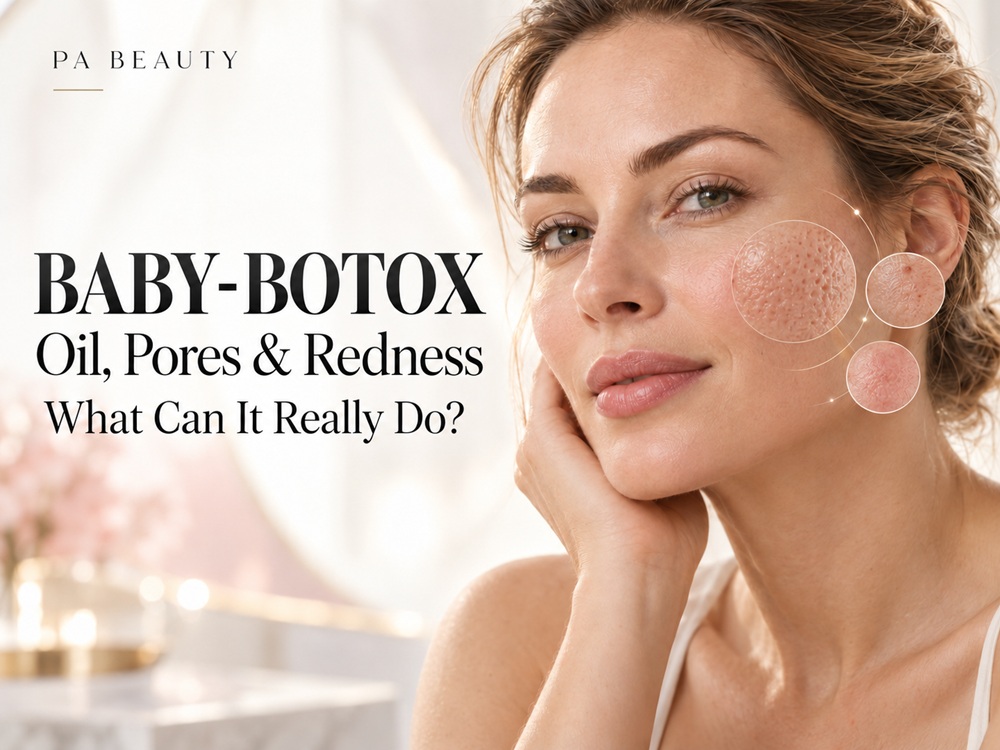
Shiny skin by lunchtime, visible pores around the cheeks, and redness that never quite settles—these concerns often appear together. But they do not necessarily have the same cause or need the same treatment.
You may have seen “Baby Botox,” “Micro-Botox,” or “skin Botox” promoted as a shortcut to smoother, clearer-looking skin. There is some research behind superficial botulinum toxin injections, particularly for excess oil and pore appearance. However, results vary, and redness needs a separate assessment.
Micro-Botox may help selected patients with oiliness and visible pores, but it cannot permanently close pores, cure rosacea, or replace appropriate skincare and medical treatment.
Are Baby Botox and Micro-Botox the Same?
The terms are often used interchangeably online, but they describe different treatment ideas.
Baby Botox usually means using a smaller amount of botulinum toxin in selected facial muscles to soften expression lines while preserving movement. It is a marketing term rather than a standardized medical protocol.
Micro-Botox generally refers to placing small amounts of botulinum toxin superficially, often within the skin, across a treatment area. The aim may include improving oiliness, skin texture, or the appearance of pores rather than primarily relaxing deeper facial muscles.
| Treatment term | Typical approach | Main goal |
|---|---|---|
| Conventional Botox | Injections into selected facial muscles | Soften appropriate expression lines |
| Baby Botox | A conservative approach to muscle treatment | Subtle wrinkle reduction with retained movement |
| Micro-Botox | Multiple small, superficial injections | Address selected skin-quality concerns |
Terminology varies between providers. Before booking, ask what the treatment actually involves, which product will be used, and whether the intended use is approved locally or off-label.
Botox is also a brand name. Different botulinum toxin products have different characteristics, and their units are not interchangeable.
Can Micro-Botox Reduce Oily Skin?
It may reduce oil production in some patients, but the evidence is still limited and mixed.
A small study involving 25 patients found reduced forehead sebum production after intradermal botulinum toxin treatment, with improvements measured for up to three months. However, the researchers called for larger, randomized, placebo-controlled studies.
Another randomized, split-face study found improvements in certain skin-texture measures but no significant reduction in sebum secretion. This matters: a positive result with one product, technique, or facial area does not guarantee the same result elsewhere.
For someone troubled by persistent facial shine, Micro-Botox may be worth discussing after an assessment. It should not automatically be the first step.
A consultation should also review your current cleanser, moisturizer, sunscreen, acne treatments, and any irritation caused by your routine.
Can Micro-Botox Make Enlarged Pores Look Smaller?
Possibly—but improving pore appearance is different from permanently shrinking or closing pores.
Visible pores may reflect a combination of oil production, follicular blockage, skin elasticity, sun damage, and individual anatomy. Treating only one factor may produce a modest change.
In a 20-patient split-face pilot study, the botulinum toxin-treated side showed greater improvement in oiliness and pore scores than the saline-treated side. Improvement was still recorded at four months. Nevertheless, this was a small study, not proof that everyone will obtain the same result.
Other research has found only short-lived improvement in pore size. A realistic goal is therefore less noticeable pores and a smoother-looking surface, rather than “poreless skin.”
If congestion, acne scars, or loss of elasticity is the main concern, a different treatment plan may be more appropriate.
Can Micro-Botox Help Facial Redness?
This is the area where careful diagnosis matters most.
Facial redness can come from rosacea, irritation, contact dermatitis, visible blood vessels, or other skin conditions. Redness accompanied by burning, stinging, or persistent inflammation should not automatically lead to an injection recommendation.
Small controlled trials have investigated intradermal botulinum toxin for rosacea-associated redness. A 30-patient randomized, split-face study reported improvements in several clinician-assessed redness measures at one month. These findings are promising, but short follow-up and small participant numbers limit what they can establish.
Micro-Botox is not an established universal treatment for redness or sensitive skin. It does not remove the need for a rosacea diagnosis, appropriate skincare, trigger management, or prescribed treatment when indicated.
If your skin is currently inflamed or reacting to products, assessment and stabilization may be more useful than adding another procedure.
Does Micro-Botox Repair the Skin Barrier?
Claims that Micro-Botox “repairs sensitive skin” go beyond what current evidence can reliably support.
One small rosacea trial reported improvements in hydration and redness, but it did not find a significant improvement in transepidermal water loss—a measure used when assessing skin-barrier function. Better hydration does not, by itself, demonstrate barrier repair.
Oiliness and dehydration can also coexist. A shiny complexion does not necessarily mean your skin needs stronger oil control.
For someone with tightness, flaking, and stinging, a simpler routine and appropriate medical assessment may need to come first.
What About Micro-Botox With HA, PDRN or Exosomes?
Combination treatments are often marketed as “glass skin” packages, but adding more ingredients does not automatically produce better results.
Hyaluronic acid, PDRN, exosome products, and botulinum toxin are different substances. Evidence for one does not establish the safety or effectiveness of a mixture.
Before considering a combination, ask:
What is each component intended to improve?
Is the specific product authorized for the proposed use and route?
Will the products be used separately or mixed?
What evidence supports their compatibility?
What additional risks and recovery time could the combination introduce?
A personalized plan may involve separate treatments—or fewer treatments. The decision should follow the main skin concern, product suitability, and clinical assessment.
How Long Do Results Last?
There is no single reliable timetable for every Micro-Botox treatment.
Small studies have reported improvements lasting from several weeks to a few months, depending on the outcome measured. Oil reduction, pore appearance, and texture may not improve together or last equally long.
Results are temporary. Your practitioner should explain when to assess the outcome and why any repeat treatment is appropriate, rather than promise a fixed duration.
If you are visiting Beijing briefly, share your arrival date, departure date, and any important event dates before booking. Allow time for recovery and follow-up.
What Are the Risks?
Superficial injections still carry medical risks.
Possible effects include discomfort, temporary injection bumps, redness, swelling, bruising, and infection. If toxin affects nearby muscles, unwanted weakness or facial asymmetry can occur. One randomized cheek study reported a case of facial palsy, showing that superficial placement does not eliminate muscle-related risk.
Botulinum toxin labeling also warns about rare serious effects, including swallowing, speaking, or breathing difficulties. These symptoms require immediate medical attention. Your clinician should review your medical history, medications, previous toxin treatments, and any relevant neuromuscular conditions before treatment.
The word “micro” should never be interpreted as “risk-free.”
Considering Micro-Botox in Beijing?
At PA BEAUTY in Shunyi, the starting point is understanding what is driving your concern.
A complimentary VISIA skin analysis can help document visible skin features and provide a baseline for discussion. It supports assessment, but does not replace a medical diagnosis of rosacea, dermatitis, or another skin condition.
Depending on your needs, the next step may be a skincare review, gentle hydration, medical referral, or consultation about an appropriate procedure.
The goal is not to make every client less oily. It is to choose a plan that fits the skin in front of us.
Contact PA BEAUTY through beijingpabeauty.com to arrange an English-language consultation. Please bring your current skincare list and details of any previous injections, laser treatments, or skin reactions.
This article provides general education. Treatment suitability, product selection, and approval status require individual assessment by an appropriately qualified medical professional.
// Popular Feeds
-

-

-

-

Why Skin Becomes Sensitive and Red?
Mar 18,2026 -

-

 WhatsApp
 Email
 +86 13811248726