

Brow Lift, Upper Blepharoplasty or Botox? What Actually Causes Hooded Eyes?
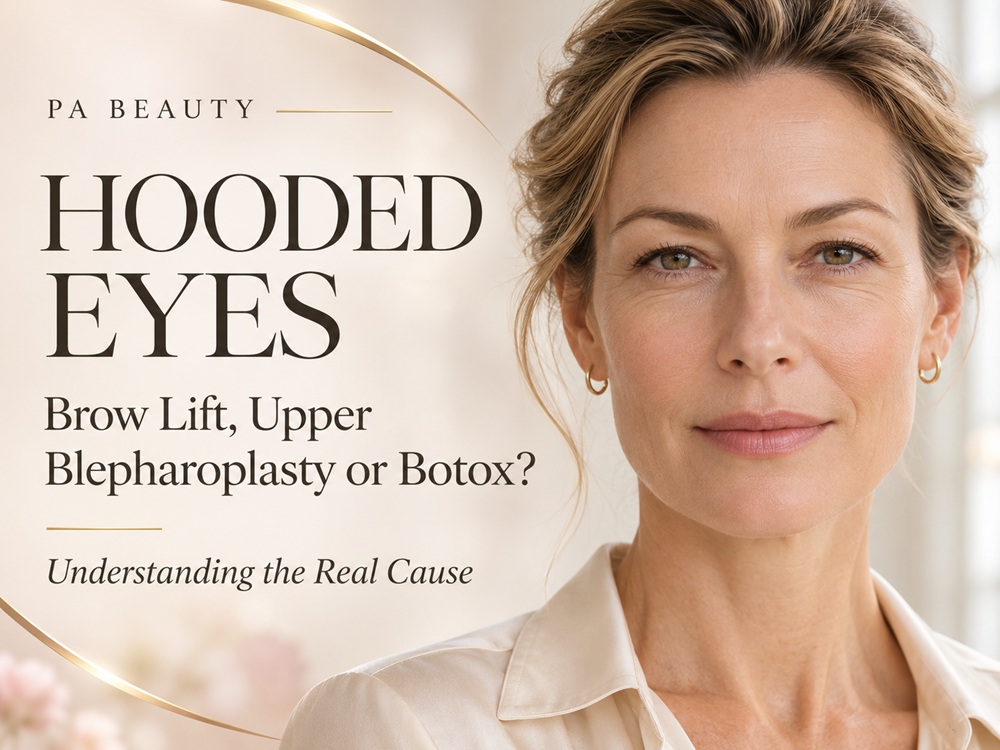
Your upper eyelids look heavier. Eyeliner disappears into the crease, eyeshadow transfers, or you find yourself raising your eyebrows to make your eyes look more open.
Does that mean you need Botox, a brow lift, or upper eyelid surgery?
The right treatment depends on what is creating the hooding: a low eyebrow, excess upper eyelid skin, a drooping eyelid margin—or a combination. These are different anatomical problems, so the treatments are not interchangeable.
Some people also have naturally hooded eyes from a young age. Hooding alone does not mean something is wrong or that treatment is necessary.
What Are Hooded Eyes?
“Hooded eyes” is a descriptive term, not a diagnosis. It usually refers to skin or tissue that partly covers the upper eyelid crease, leaving less visible eyelid space.
The appearance may be inherited, develop gradually with aging, or become more noticeable after changes in brow position.
A consultation should examine the eyebrow, eyelid skin and eyelid margin separately. The American Academy of Ophthalmology emphasizes that excess skin, brow descent and true eyelid ptosis can occur together and may produce similar complaints of heaviness.
1. Low Eyebrows: When Hooding Starts Above the Eyelid
The eyebrow and forehead help frame the upper eye area. When the brow sits lower, tissue beneath it can gather over the eyelid, particularly toward the outer corner.
This is called brow ptosis, or brow descent.
You may notice that the outer eye area looks heavier or that you habitually lift your eyebrows to feel more open-eyed. However, these observations cannot establish the diagnosis by themselves.
A surgical brow lift repositions brow and forehead tissues. It may improve upper eyelid hooding when a low brow is a significant contributor. It does not directly correct every eyelid problem.
The key question is whether the brow needs repositioning, rather than assuming all visible folding is extra eyelid skin.
2. Excess Upper Eyelid Skin: When Blepharoplasty May Help
Some people have an appropriate brow position but extra upper eyelid skin that folds over the crease or rests near the eyelashes.
This is known as dermatochalasis.
Upper blepharoplasty is surgery that removes a carefully planned amount of excess skin. Depending on the anatomy, the surgeon may also address selected fat or other tissues. In some patients, excess skin affects the visual field as well as appearance.
The aim is not to remove as much skin or fat as possible. The surgeon must preserve comfortable eye closure and account for the person’s existing eye shape.
Upper blepharoplasty treats excess eyelid tissue. It does not automatically lift a low brow or repair the mechanism that raises the eyelid.
3. True Eyelid Ptosis: When the Eyelid Edge Sits Too Low
A third possibility is blepharoptosis, usually shortened to ptosis.
Here, the upper eyelid margin—the edge carrying the eyelashes—sits lower over the eye. The issue involves the eyelid’s lifting mechanism, rather than simply a fold of loose skin.
Age-related stretching or separation of the lifting tendon is one possible cause, but other causes require consideration. An ophthalmologist may examine eyelid movement, pupil responses and eye movements before recommending treatment.
Ptosis repair addresses the eyelid’s lifting mechanism. Removing skin alone may leave the low eyelid margin unchanged.
This is why a consultation for “hooded eyes” may lead to a discussion of ptosis repair, even if you originally asked about cosmetic eyelid surgery.
Brow Lift, Blepharoplasty or Botox: What Is the Difference?
| Option | Main target | Important limitation |
|---|---|---|
| Surgical brow lift | Low brow position and descended forehead tissues | Does not directly repair true eyelid ptosis |
| Upper blepharoplasty | Excess upper eyelid skin, with selected tissue adjustment | Does not automatically correct a low brow or low eyelid margin |
| Botox brow lift | Muscle activity influencing brow position | Provides a modest, temporary change in suitable patients |
| Ptosis repair | The mechanism lifting the upper eyelid | Requires assessment of the cause and eyelid function |
Some patients benefit from a combination. Others need only one procedure—or may decide that no treatment is necessary.
Can Botox Lift Hooded Eyes?
Botox can create a subtle brow lift in selected patients, but it cannot remove excess skin.
A “Botox brow lift” involves selectively relaxing muscles that pull the brow downward, allowing the muscles that elevate it to have relatively more influence.
The result depends on existing brow position, muscle activity and anatomy. It is generally a smaller, temporary adjustment rather than the structural repositioning achieved by surgery.
It may be worth discussing when muscle activity contributes to mild brow heaviness. It is unlikely to meet expectations when there is substantial excess skin, significant brow descent or true eyelid ptosis.
The phrase “non-surgical eye lift” should therefore come with a clear explanation of the expected change.
Why Can Forehead Botox Make the Eyes Feel Heavier?
The forehead muscle, called the frontalis, raises the eyebrows.
Some people use it habitually to compensate for a low brow or heavy upper eyelid tissue. Their forehead lines may partly reflect that effort.
Relaxing this muscle can reduce its lifting action. In a person relying on it for support, the brow may sit lower and the eye area can feel heavier. Brow ptosis and eyelid ptosis are also recognized potential adverse effects of botulinum toxin treatment.
This makes assessment before treatment particularly important. A plan should consider:
- Brow position when the forehead is relaxed.
- Whether you constantly raise your eyebrows.
- Existing asymmetry or hooding.
- Previous reactions to Botox.
- The balance between wrinkle reduction and maintaining brow support.
If heaviness develops after injections, contact the treating clinician. Additional Botox is not an automatic solution: brow descent and eyelid ptosis need to be distinguished before considering management.
Can You Have Both a Low Brow and Excess Eyelid Skin?
Yes. Brow descent, excess skin and true eyelid ptosis can coexist.
This helps explain why two people with similar-looking hooding may receive different recommendations.
During an examination, a surgeon may gently support the brow in an appropriate position to assess how much eyelid folding remains. They will also examine the eyelid margin and lifting function. This is part of clinical assessment, rather than a reliable home test for choosing surgery.
A combined procedure may be appropriate, but more procedures do not automatically produce a better result. Each should address a finding that matters to your appearance, function or goals.
What Should a Proper Consultation Include?
A useful consultation goes beyond deciding how much skin appears visible in a photograph.
The clinician should review your concerns and assess brow position, eyelid movement, symmetry, eye closure and the ocular surface. Dry-eye symptoms, previous eye surgery and recent Botox are particularly relevant.
If vision is affected, visual-field testing may be appropriate. Standard photographs can help document the starting point and support surgical planning.
Bring details of:
- Previous eyelid, brow or facial surgery.
- Botox treatment dates and areas.
- Dry eyes, irritation or contact-lens difficulties.
- Eye conditions and previous eye procedures.
- Medications, supplements and relevant medical history.
- Your preferred result, including features you want to preserve.
VISIA imaging can document skin features, but it does not diagnose eyelid ptosis or replace an eye examination.
What Are the Risks and Recovery Considerations?
Botox may cause bruising, asymmetry or unwanted brow or eyelid changes. Surgery involves a different set of risks and recovery needs.
Upper eyelid surgery can cause swelling, bruising, dryness, difficulty closing the eyes, scarring or a need for revision. Rare serious complications include vision loss. Brow lift risks include altered sensation, scarring, hairline changes and nerve injury. These possibilities should be discussed with the operating surgeon.
Recovery depends on the procedure, your health and healing response. Looking socially presentable is not the same as being fully healed.
For international patients, arrange follow-up, incision care and an appropriate travel plan before committing. A short Beijing visit may be suitable for consultation without being long enough for surgery and postoperative review.
When Is a Drooping Eyelid Urgent?
A suddenly drooping eyelid needs prompt medical assessment, especially with double vision, unequal pupils, severe headache, eye pain or other neurological symptoms.
These changes can have causes that require urgent investigation. Do not wait for a cosmetic appointment or assume a sudden change is normal aging.
Considering Treatment for Hooded Eyes in Beijing?
Begin with a specific question: Is the heaviness coming from the brow, excess eyelid skin, the eyelid lifting mechanism, or more than one area?
At PA BEAUTY in Shunyi, an English-language consultation can help clarify your concerns and whether assessment by an ophthalmologist, oculoplastic surgeon or plastic surgeon is appropriate.
For clients considering surgery in China, ChinaEliteMed can help coordinate specialist consultations and discuss the practical requirements for international patients. The surgical recommendation should come from the examining specialist.
The goal is a comfortable, natural-looking result that respects your eye shape—not simply the highest brow or the largest possible eyelid space.
Visit beijingpabeauty.com to arrange an initial consultation, or chinaelitemed.com for surgical consultation coordination.


 WhatsApp
 Email
 +86 13811248726