

Can You Reverse Sun Damage? Pigmentation & Photoaging Treatments in Beijing
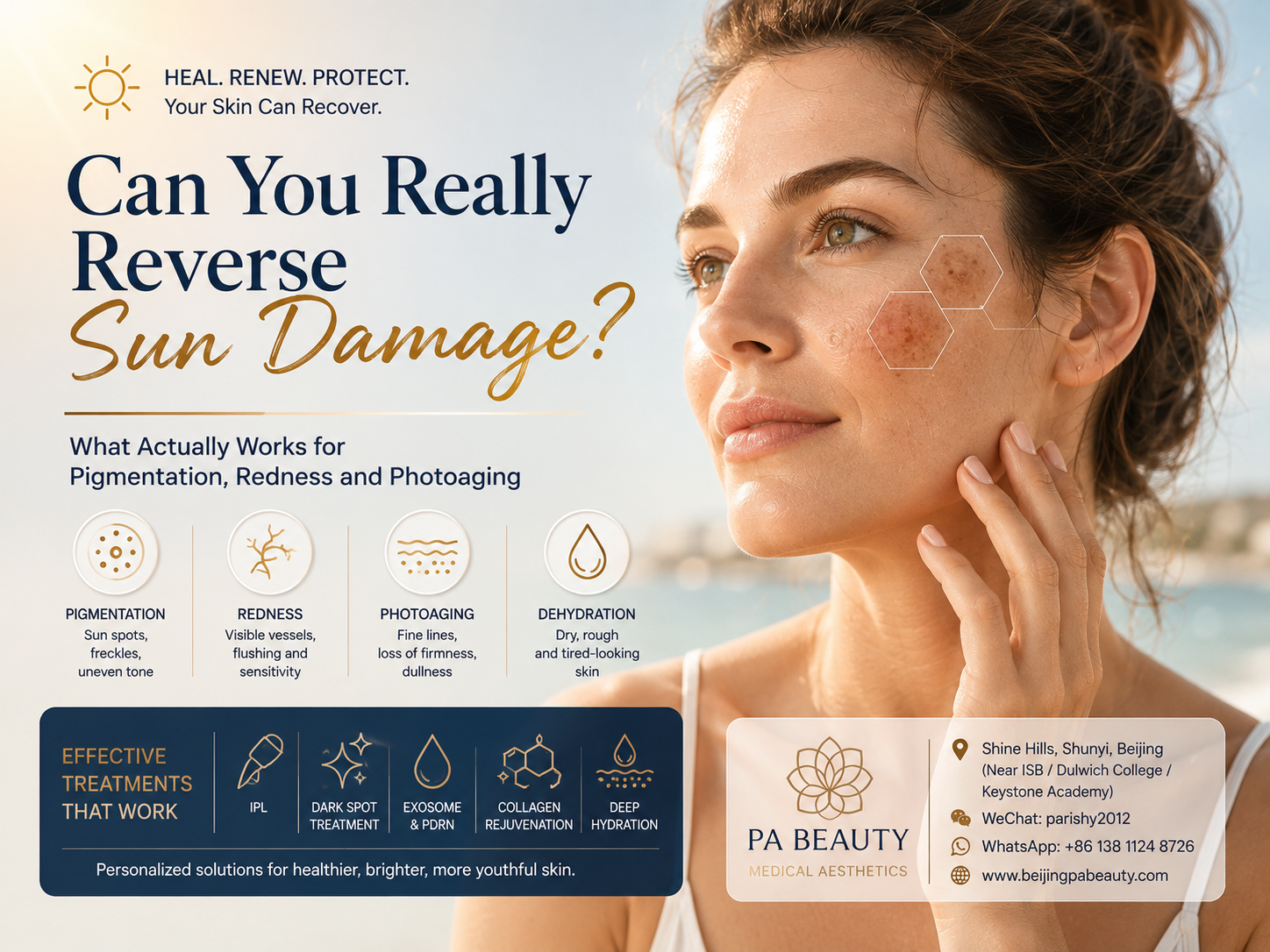
After a summer holiday, beach trip, or weeks of outdoor activities, you may notice something unexpected when you look in the mirror.
Your skin suddenly seems older.
Perhaps you see new freckles or dark spots. Your complexion looks uneven. Redness seems more noticeable. Your skin feels drier, rougher, or less radiant than it did before summer.
This is often not simply a temporary tan.
It may be sun damage — also known as photoaging.
The good news is that while we cannot literally erase every biological effect of UV exposure, many visible signs of sun damage can be significantly improved with the right combination of sun protection, skincare, and professional treatments.
So, what actually works?
Let’s look at pigmentation, redness, texture, and collagen loss separately — because they are not the same problem and usually should not be treated in exactly the same way.
What Is Sun Damage?
Sunlight contains ultraviolet radiation, particularly UVA and UVB, that affects the skin in different ways.
UVB is strongly associated with sunburn and direct DNA damage, while UVA penetrates more deeply into the skin and contributes substantially to premature skin aging.
Over time, repeated UV exposure can contribute to:
Freckles and sun spots
Uneven pigmentation
Persistent redness
Dullness
Rough or uneven texture
Fine lines
Loss of elasticity
Collagen degradation
Premature skin aging
This cumulative process is known as photoaging.
And it doesn't only happen during a beach holiday.
Daily exposure during walking, driving, sightseeing, exercising outdoors, or simply living in a sunny environment adds up over the years.
Why Can Your Skin Suddenly Look Older After Summer?
One reason is pigmentation.
Dark spots create contrast across the face, making the complexion appear less even. Even without significantly deeper wrinkles, uneven pigmentation can make skin look visually older.
But pigmentation is only part of the story.
UV exposure can also increase oxidative stress and contribute to the breakdown of collagen and other components of the extracellular matrix.
At the same time, heat, sun exposure, travel, air conditioning, swimming, and disrupted skincare routines can leave the skin dehydrated or irritated.
The result may be a combination of:
pigmentation + redness + dehydration + collagen damage.
This is why simply applying a brightening cream may not fully address what you see after summer.
Can Sun Damage Really Be Reversed?
This needs a nuanced answer.
Existing UV-related cellular damage cannot simply be “undone” as though it never happened.
However, many of the visible consequences of photoaging can be improved considerably.
Depending on your skin condition, professional treatment may help improve:
Brown pigmentation
Freckles and sun spots
Redness
Uneven skin tone
Dullness
Rough texture
Dehydrated appearance
Some signs of collagen loss
The most effective strategy depends on what type of sun damage you actually have.
1. Pigmentation and Sun Spots: IPL Can Be an Effective Option
If your main concern is scattered brown pigmentation, freckles, or sun spots, IPL (Intense Pulsed Light) may be an appropriate option for selected skin types and pigment patterns.
IPL uses controlled pulses of broad-spectrum light that can target pigment and vascular chromophores.
For suitable candidates, IPL may help improve:
Freckles
Sun-induced pigmentation
Uneven skin tone
Certain superficial vascular redness
Overall photodamaged appearance
One advantage of IPL is that it can address several visible signs of photoaging rather than focusing only on one individual spot.
However, not every form of pigmentation should be treated the same way.
For example, melasma can behave very differently from freckles or solar lentigines and may sometimes worsen with inappropriate heat- or light-based treatment.
This is why correct assessment matters before choosing IPL or another pigmentation treatment.
2. What About Darker or More Stubborn Spots?
Some isolated dark spots may require a more targeted approach.
At PA BEAUTY, we first consider factors such as:
Depth and appearance of the pigmentation
Whether pigmentation is scattered or localized
Skin sensitivity
Recent sun exposure
Previous pigmentation treatments
Risk of post-inflammatory hyperpigmentation
For some clients, targeted dark spot treatment may be more appropriate than treating the entire face aggressively.
The goal should not simply be:
“Use the strongest treatment possible.”
It should be:
Use the most appropriate treatment with the lowest unnecessary risk to the surrounding skin.
3. Redness After Sun Exposure Needs a Different Strategy
Not all sun damage is brown.
Some people notice that after summer their skin becomes:
Redder
More reactive
Easily flushed
Sensitive to skincare products
Uncomfortable after cleansing
In this situation, immediately using aggressive exfoliation or pigmentation treatments may make the problem worse.
The first priority may instead be:
calming the skin and restoring the skin barrier.
Hydration-focused facials, gentle skin management, and carefully selected professional treatments can help the skin return to a more stable condition before stronger rejuvenation procedures are considered.
For appropriate clients, IPL may also be considered for certain vascular redness concerns.
4. Dehydration Can Make Sun Damage Look Worse
After a holiday, clients often tell us:
“My skin suddenly looks much older.”
But sometimes part of what they are seeing is dehydration.
When the skin lacks sufficient hydration, fine lines become more visible and the surface may appear:
Rough
Dull
Tired
Less plump
This is especially common after a combination of:
Long flights
Strong sun exposure
Air conditioning
Swimming
Alcohol
Irregular sleep
Restoring hydration can therefore be an important first step in post-travel or post-summer skin recovery.
At PA BEAUTY, depending on skin condition, this may involve professional deep hydration treatments or more advanced hydration-focused skin rejuvenation.
5. What About Collagen Damage From the Sun?
This is one of the less visible but important aspects of photoaging.
Chronic UV exposure contributes to changes in dermal collagen and elastin, which over time can contribute to:
Fine lines
Reduced firmness
Loss of elasticity
Thinner or less resilient-looking skin
Pigmentation treatment alone does not fully address this part of photoaging.
For clients whose concern is not only spots but also overall aging skin quality, a broader rejuvenation strategy may be appropriate.
At PA BEAUTY, this can include collagen-focused treatments designed to support gradual improvement in skin firmness, texture, and overall quality.
6. Where Do Exosome and PDRN Treatments Fit?
Some clients have both photodamage and poor overall skin quality.
Their concern is not simply:
“I have a brown spot.”
It is:
“My whole face looks tired, dry and older after summer.”
In these cases, skin rejuvenation treatments may be incorporated after assessing the condition of the skin.
At PA BEAUTY, personalized protocols may include Exosome Mesotherapy, PDRN and Hyaluronic Acid, depending on individual goals.
These approaches are used with the aim of supporting hydration, recovery, and overall skin-quality improvement rather than directly “removing” UV damage itself.
That distinction is important.
The Best Treatment May Be a Combination — Not One Machine
Modern photoaging treatment is increasingly personalized because different signs of sun damage occur at different levels of the skin.
For example, one person may mainly have:
Freckles + otherwise healthy skin
while another may have:
Pigmentation + redness + dehydration + collagen loss.
These two people should not automatically receive the same treatment.
A personalized plan might therefore combine, at different stages:
IPL for suitable pigmentation or redness
Targeted dark spot treatment
Deep hydration
Skin barrier support
Collagen rejuvenation
Exosome/PDRN-based skin-quality treatments
Daily sunscreen and appropriate home skincare
The goal is not to perform as many procedures as possible.
It is to identify what is actually making your skin look older and address those problems appropriately.
What Results Do Clients Notice?
For many international clients, the goal is not perfectly flawless skin.
They want their complexion to look:
Clearer
Brighter
More even
Less tired
Healthier
Naturally younger
This is also why we increasingly think about pigmentation treatment as part of skin rejuvenation, rather than simply “removing spots.”
When uneven pigmentation, dehydration and poor skin quality improve together, the overall face can appear fresher even without changing facial features.
How Can You Prevent Sun Damage From Coming Back?
Professional treatments cannot replace sun protection.
If you are investing in pigmentation or photoaging treatments, daily UV protection becomes even more important.
A sensible routine includes:
Broad-spectrum sunscreen
Adequate SPF
Reapplication during prolonged outdoor exposure
Hats and shade when practical
Avoiding unnecessary intense midday sun
Gentle skincare after significant sun exposure
And importantly:
Do not deliberately tan immediately before or after many light-based treatments.
Your treatment provider should give you specific pre- and post-treatment instructions.
Frequently Asked Questions About Sun Damage
Can old sun damage be treated years later?
Yes, many visible signs of accumulated photodamage can still be treated later in life.
However, the appropriate treatment depends on whether the concern is pigmentation, redness, texture, collagen loss, or a combination.
Can IPL remove sun spots permanently?
IPL can significantly improve suitable superficial pigmentation, but it does not make your skin immune to future UV damage.
New pigmentation can develop with continued sun exposure, which is why sunscreen remains essential.
Is IPL good for freckles?
IPL can be effective for certain types of freckles and superficial pigmentation in appropriately selected patients.
A consultation is important because not all pigmentation behaves the same way.
What is the best treatment for sun-damaged skin?
There is no single “best” treatment.
If pigmentation is the main problem, a pigment-targeting treatment may be appropriate.
If the skin is red and sensitive, barrier recovery may come first.
If photoaging includes loss of firmness and skin quality, collagen and rejuvenation treatments may also be considered.
The best approach is usually diagnosis first, treatment second.
I just came back from vacation. Can I do IPL immediately?
Not always.
If your skin is recently tanned, sunburned, inflamed, or highly sensitive, it may be better to allow the skin to recover before certain light-based procedures.
Always tell your provider about recent sun exposure before treatment.
Can skincare alone reverse photoaging?
Good skincare — especially sunscreen, moisturization, and evidence-based active ingredients — can make a meaningful difference and is essential for prevention.
However, established pigmentation, vascular changes, or more advanced photoaging may respond better when professional treatment is combined with an appropriate home routine.
Sun Damage Is More Than Dark Spots
One of the biggest changes in modern anti-aging is understanding that photoaging is multidimensional.
The question is no longer simply:
“How do I remove this spot?”
A better question is:
“What has sun exposure changed in my skin, and which of those changes can we improve?”
For one person, the answer may be IPL.
For another, it may begin with hydration and barrier repair.
For someone with more advanced photoaging, it may require a combination of pigmentation treatment, collagen rejuvenation and skin-quality improvement.
That is why personalized assessment matters.
Sun Damage & Pigmentation Treatment for International Clients in Beijing
PA BEAUTY is an English-speaking boutique medical aesthetics and skin rejuvenation clinic located in Shine Hills, Shunyi, Beijing.
Since 2017, we have served international clients from around the world and developed extensive experience working with different skin types, sensitivities and aesthetic expectations.
Our philosophy is simple:
Treat the skin you actually have — not simply the name of the treatment you saw online.
If you are concerned about freckles, sun spots, redness, dehydration or premature photoaging after summer or travel, we can assess your skin and discuss which options may be appropriate.
PA BEAUTY Beijing
📍 Shine Hills, Shunyi, Beijing
Near ISB / Dulwich College Beijing / Keystone Academy
📱 WeChat: parishy2012
📞 WhatsApp: +86 138 1124 8726
🌐 www.beijingpabeauty.com


 WhatsApp
 Email
Email
 +86 13811248726