

Why Does My Concealer Crease Under My Eyes? Dryness, Fine Lines and Under-Eye Hollows Explained
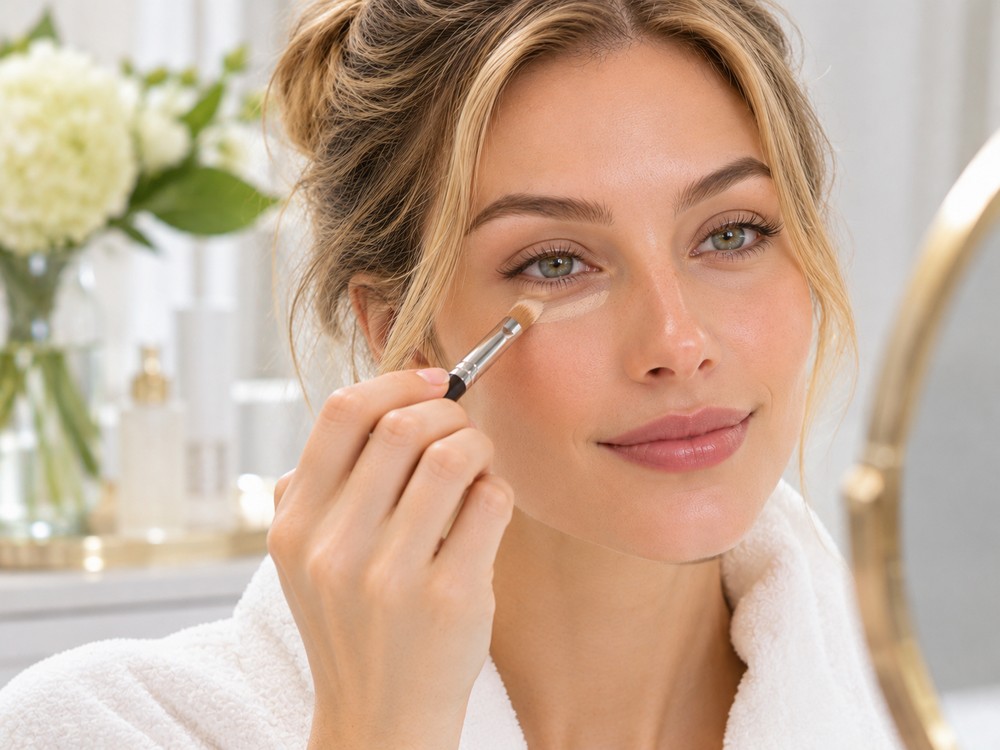
You put your concealer on in the morning and it looks smooth. By midday it has settled into every fine line under your eyes, gone patchy, or gathered in the crease where your lower lid meets your cheek. Changing the brand rarely fixes it — because in most cases the concealer is not the problem. The skin underneath it is.
There are three usual causes, and they need different fixes. Working out which one you have is the whole point — a product that helps dryness does nothing for a hollow, and no cream fills a shadow.
1. Dryness: The Skin Under Your Eyes Is Thirsty
The skin under the eyes is the thinnest on the face, with almost no oil glands of its own. In Beijing's heated, dry winter air it loses moisture fast. Dry skin is not smooth — under a magnifier it looks like a dry riverbed, full of tiny ridges. Concealer sits on top of those ridges, then sinks into them as the day goes on and the product dries further.
Signs it is dryness: the area feels tight, especially after washing your face; the creasing is worse in winter or in air-conditioned rooms; a rich eye cream worn for a few days makes it visibly better; the skin looks dull as well as lined.
Makeup can help a little here: a hydrating eye cream left to sink in for a few minutes before concealer, a creamy rather than matte formula, and less product, not more. But makeup only covers dryness for a few hours. If the skin itself is dehydrated, the creasing comes back every day — that is a skin problem, not a makeup problem.
2. Fine Lines: The Skin Has Lost Elasticity
Fine lines under the eyes are different from dryness, though the two often come together. They are there in the morning before any makeup goes on, and they deepen when you smile. They appear when the skin has lost collagen and elasticity — from age, sun, smoking, or simply years of the thinnest skin on the face moving every time you blink and smile.
Signs it is fine lines: the lines are visible on bare skin, not only after makeup; they are there when the skin feels well moisturised; they look worse in harsh overhead light and in photos.
No concealer fills a fine line, and a thick one makes it worse — heavy product settles into the line and draws the eye to it. A thin layer, pressed in rather than dragged, looks better. But that is damage control. Lines are a structural change in the skin, and only a treatment that works on the skin itself can change them.
3. Under-Eye Hollows: A Shadow, Not a Line
The third cause is the one most people miss. Under-eye hollows — the dip that runs from the inner corner of the eye toward the cheek, sometimes called a tear trough — create a shadow. Concealer cannot fill a shadow. You can put product on the dark area, but the dip is still there, and as the product moves during the day it collects in the dip and makes the hollow look deeper.
Signs it is a hollow: the darkness is worst in overhead or side light and softens in soft front light; it is there even when you are well rested and well hydrated; it runs in the family, or it appeared as the face lost volume with age; pressing the area gently does not make it go away.
This is also where "dark circles" get confusing. A hollow casts a shadow that looks like a dark circle, but the skin itself may not be pigmented at all. Pigmented dark circles are a different cause again — the skin itself is darker — and they need a different answer. Telling the three apart (dryness, lines, hollow, pigmentation) is not something a photo can do reliably. It is decided in person, at a free skin analysis, where the skin is seen in proper light and measured.
What Makeup Can Do — and Where It Stops
A few makeup habits genuinely help, whatever the cause:
Prep first, and wait. Eye cream needs a few minutes to sink in. Concealer applied on top of wet cream slides and creases faster.
Use less product. One thin layer, pressed in with a fingertip or a damp sponge, creases less than two thick ones. Build up only where you need coverage.
Skip heavy powder under the eyes. Powder is designed to set makeup, but on dry or lined skin it dries the area further and settles into lines. If you set at all, use the smallest amount, only where the concealer moves.
Choose a creamy, flexible formula over a dry matte one. Matte concealers look good for an hour and then crack on moving skin.
That is the honest limit of makeup. If the cause is dehydration, a treatment that restores hydration lasts longer than any primer. If the cause is fine lines or lost volume, no product changes the structure underneath.
What Actually Fixes Each Cause
This is where the answer has to be personal, because the three causes point in different directions — and the wrong treatment for the wrong cause wastes money.
It starts with a free VISIA skin analysis. The analysis shows hydration levels, fine lines, pigmentation and texture, so the cause is identified before anything is recommended. From there, the service ladder is simple:
Deep cleansing, hydration and eye care — the three basics, ¥274 together. A deep cleansing facial clears the build-up that stops skincare absorbing properly, so everything after it works better. A deep hydrating treatment restores moisture to skin that is too dry to hold makeup smoothly — dryness is the most common cause of creasing, and it is also the most fixable. And a dedicated eye treatment targets the delicate skin under the eyes, rather than treating it as an afterthought of a full-face facial.
Collagen rejuvenation for fine lines. Where lines come from lost collagen, treatments that stimulate collagen — including PDRN and exosome mesotherapy, the same regenerative approach behind our glass skin treatment — work on the skin's structure rather than covering it. PDRN and exosome treatments suit all skin types, and the plan is always set after the free analysis.
Pigmentation-type dark circles. Where the darkness is pigment in the skin rather than a shadow, a pico-second laser treatment is one of the options we use. Whether it suits you is decided at the analysis — not from a photo.
Hollows. Where the problem is a genuine tear trough hollow, tear trough filler is sometimes the answer. It is an in-person decision, made after the analysis, with a personalised quote — it is never sold from a photo or a chat message.
One thing we will not do is guess from a photo. Under-eye skin is too thin and too individual for that, and a photo taken in one light can hide a hollow and exaggerate a line at the same time. The free analysis exists precisely so the recommendation matches the real cause.
Home Care Helps — But Only So Far
Home care is useful supporting care, not a cure. A few habits make a real difference:
Wear sunscreen every day, including around the eyes. Sun damage is one of the main drivers of fine lines and pigmentation under the eyes, and it accumulates quietly.
Sleep on your back when you can, and change the pillowcase often. Pressing the same side of the face into a pillow night after night creases the thinnest skin first.
Keep the routine gentle. The under-eye area does not need strong actives scrubbed into it — harsh products thin the skin further and make lines and darkness worse.
Drink water and sleep properly, but do not expect them to fill a hollow. They help the skin look its best; they do not change its structure.
If the creasing keeps coming back in the same place despite gentler makeup and better hydration, home care has done what it can. That is the point to get the skin seen in person rather than buying another concealer.
What to Ask Before Booking an Under-Eye Treatment in Beijing
What is actually causing my creasing — dryness, lines, a hollow, or pigmentation? Ask this before anything else. The answer decides the whole plan, and it is answered at the free analysis, not over chat.
What will the treatment do, and what will it not do? A hydration treatment will not fill a hollow. A filler will not fix pigmentation. An honest clinic tells you which cause each treatment addresses before you book.
How is the plan priced? Every plan is quoted after the free analysis, in writing, for your skin — not guessed from a photo or a product name.
Will I need more than one session? Some causes improve in one session; collagen treatments work over weeks. Ask what the timeline looks like for your cause, and how progress is judged.
Book a Free Skin Analysis
If your concealer creases every day, the fastest way to end the cycle is to find out which of the three causes is yours. Book a free VISIA skin analysis at PA BEAUTY and we will show you — in proper light, with measurements — whether it is dryness, fine lines, a hollow or pigmentation, and what would actually fix it.
PA BEAUTY is in Room 608, 6th Floor, Building 5, Xiangyun Town South, Shunyi, Beijing. We are open 10am–8pm, closed on Tuesdays. Message us on WhatsApp at +86 13811248726 or add us on WeChat (ID: 64482369) to book your free analysis.
FAQ
Why does my concealer crease even when I use primer? Primer helps makeup grip, but it cannot change the skin underneath. If the cause is dryness, fine lines or a hollow, the creasing returns once the primer wears off. The fix is to treat the cause, not to add another layer.
Is it dryness or fine lines? If the area feels tight and improves after a few days of good eye cream, dryness is the main cause. If the lines are visible on bare, well-moisturised skin, they are fine lines — a structural change, not a moisture problem. A free VISIA analysis measures both, so you do not have to guess.
Can concealer make under-eye hollows look worse? Yes. Product collects in the dip and the shadow deepens as the day goes on. Less product, pressed in thinly, looks better — but only a treatment assessed in person can change the hollow itself.
Do I need filler for under-eye hollows? Not always. Some hollows improve with hydration and collagen treatments; some need filler. It is an in-person decision after the free analysis, with a personalised quote.
Can a photo tell me which cause I have? No. Lighting changes everything under the eyes — the same face can look hollow in one photo and lined in another. That is why we assess it in person, free, before recommending anything.


 WhatsApp
 Email
 +86 13811248726