

PDRN Skincare vs PDRN Mesotherapy: Can a “Salmon DNA” Serum Deliver the Same Results?
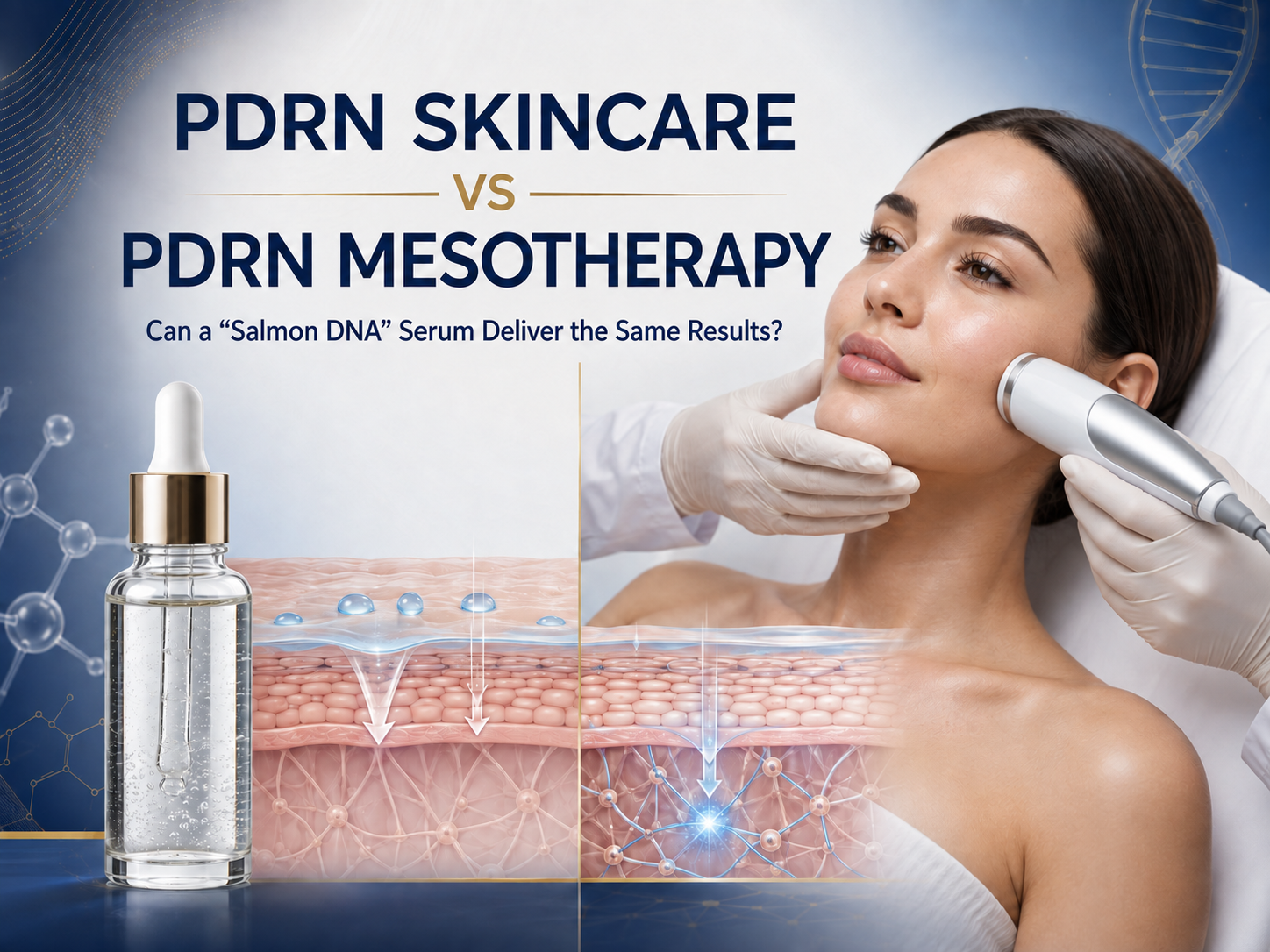
PDRN has become one of the most talked-about ingredients in Korean skincare and regenerative aesthetics.
PDRN creams, serums, masks and ampoules are promoted for:
Glass skin
Improved hydration
Smoother texture
Reduced redness
Skin-barrier repair
Collagen support
Post-treatment recovery
At the same time, aesthetic clinics offer PDRN mesotherapy or injectable polynucleotide treatments for many of the same concerns.
This creates an obvious question:
If a PDRN serum contains the same “salmon DNA” ingredient, can it produce the same results as PDRN mesotherapy?
The short answer is no—not usually.
Topical PDRN skincare may support hydration, comfort and the appearance of the skin’s surface. Mesotherapy places a suitable injectable product beneath the skin barrier, where it may produce more noticeable changes in texture, elasticity and overall skin quality.
However, injections also involve more discomfort, downtime, cost and medical risk. Neither option should be presented as a miracle treatment, and neither can replace every filler, laser or collagen-stimulating procedure.
What Is PDRN?
PDRN stands for polydeoxyribonucleotide. It consists of purified DNA fragments, traditionally obtained from the reproductive cells of salmonid fish such as salmon or trout.
This is why social media frequently calls it:
Salmon DNA
Salmon sperm facial
Salmon DNA injection
Salmon DNA serum
These names are memorable but scientifically simplified. A properly manufactured PDRN product does not consist of untreated fish reproductive material. It undergoes extraction, purification and processing to isolate selected DNA fragments and remove unwanted substances.
PDRN is also related to—but not necessarily identical to—the broader category of polynucleotides, often abbreviated as PN.
The terms PDRN and PN are frequently used interchangeably in beauty marketing, but products may differ in:
DNA-chain length
Molecular weight
Concentration
Purity
Source
Formulation
Intended use
Regulatory classification
Method of administration
Consequently, two products displaying “PDRN” on their labels may not deliver identical results.
How Is PDRN Thought to Affect the Skin?
Laboratory and clinical research suggests that PDRN and related polynucleotides may influence tissue-repair pathways, inflammation, hydration and fibroblast activity.
Potential mechanisms discussed in the scientific literature include:
Activation of adenosine A2A receptors
Support for tissue-repair processes
Provision of nucleotides through salvage pathways
Modulation of inflammatory activity
Support for fibroblast activity and extracellular-matrix production
Improved conditions for collagen and elastin maintenance
These proposed mechanisms have made PDRN attractive for skin-quality treatments.
However, phrases such as “regenerates your cells” or “reverses aging” go beyond what current clinical evidence can reliably prove. Reviews of injectable polynucleotides have found promising improvements in wrinkles, hydration, texture and elasticity, but studies remain relatively small and use different products, concentrations and treatment schedules. More standardized, high-quality research is still needed. Review of polynucleotides in aesthetic medicine
What Is Topical PDRN Skincare?
Topical PDRN products are applied to the surface of the skin and may include:
Creams
Serums
Ampoules
Eye products
Sheet masks
Recovery gels
Sleeping masks
These are generally designed for regular home use.
A PDRN serum may also contain familiar cosmetic ingredients such as:
Hyaluronic acid
Glycerin
Ceramides
Peptides
Niacinamide
Panthenol
Centella asiatica
Antioxidants
This matters because the immediate softness, glow or hydration experienced after applying a PDRN product may come partly—or mainly—from the complete formula rather than PDRN alone.
What Is PDRN Mesotherapy?
PDRN mesotherapy involves delivering a product containing PDRN or related polynucleotides through multiple small injections into selected layers of the skin.
Depending on the product and treatment plan, it may be used on areas such as:
Face
Under-eye area
Neck
Décolletage
Hands
Selected scars or areas of compromised texture
PDRN may also be combined with other ingredients, such as hyaluronic acid, as part of a personalized skin-quality treatment.
Unlike a conventional dermal filler, the primary objective is generally not to create significant projection or replace large amounts of lost facial volume. The focus is more commonly on hydration, texture and overall skin quality.
PDRN Skincare vs PDRN Mesotherapy
| Factor | Topical PDRN skincare | PDRN mesotherapy |
|---|---|---|
| Delivery | Applied to the skin’s surface | Delivered through small injections |
| Skin penetration | Limited by the skin barrier and formulation | Bypasses the outer skin barrier |
| Main role | Daily hydration, barrier support and cosmetic maintenance | Professional skin-quality treatment |
| Evidence | Emerging and highly formulation-dependent | Promising but still limited and heterogeneous |
| Expected change | Usually subtle and gradual | Potentially more noticeable |
| Discomfort | Minimal | Mild to moderate |
| Downtime | Usually none | Temporary bumps, redness, swelling or bruising |
| Frequency | Regular home use | Usually performed as a treatment course |
| Risk level | Generally lower | Higher because the skin is penetrated |
| Best suited for | Maintenance and people avoiding procedures | Suitable clients seeking professional treatment |
| Can it replace filler? | No | No, not when meaningful volume replacement is required |
| Can it erase deep wrinkles or scars? | No | Not reliably as a stand-alone treatment |
Why Can’t a Serum Automatically Produce the Same Result?
The main reason is the skin barrier.
The stratum corneum—the outermost part of the epidermis—is designed to stop external substances from entering the body easily. This protection is essential, but it also makes the delivery of large cosmetic molecules difficult.
PDRN preparations can contain relatively large, negatively charged DNA fragments. Research into improved topical PDRN delivery specifically identifies molecular size and electrical charge as obstacles to skin penetration. Research on the topical-delivery limitations of PDRN
A product can therefore contain real PDRN without necessarily delivering a clinically meaningful quantity into deeper skin layers.
Actual penetration may depend on:
Molecular size
PDRN concentration
Carrier or delivery system
Product stability
Contact time
Condition of the skin barrier
Other ingredients in the formula
New technologies such as encapsulation, liposomes and modified lower-molecular-weight formulations may improve topical delivery. Nevertheless, evidence from a specially engineered laboratory formulation cannot automatically be applied to every commercial PDRN serum.
Does That Mean Topical PDRN Is Useless?
No.
A well-formulated topical product may still be useful for:
Improving surface hydration
Supporting a dry or uncomfortable skin barrier
Making skin feel softer
Producing temporary plumpness and glow
Supporting a gentle skincare routine
Maintaining skin between professional treatments
Helping people who do not want needles or downtime
Some topical studies have reported improvements in hydration, elasticity, pigmentation or barrier-related measurements. However, many have limitations such as small sample sizes, short follow-up periods, combined formulations or product-specific delivery technology.
The practical interpretation is:
Topical PDRN may be worthwhile skincare, but it should not be assumed to reproduce an injectable treatment.
Are PDRN Cream Results Sometimes Exaggerated?
Yes—especially on social media.
Before-and-after results may be influenced by:
Lighting
Camera exposure
Skin preparation
Facial oil or moisturizer
Makeup
Temporary water retention
Other active ingredients
Simultaneous professional treatments
Filters and image editing
A cream can make dehydrated skin look smoother and more luminous. That does not prove it has rebuilt significant dermal collagen or produced the same biological effect as an injected product.
Be cautious when a product claims to:
Replace injectable treatments
Permanently eliminate wrinkles
Rebuild all damaged collagen
Erase acne scars
Lift loose skin
Regenerate every layer of the skin
Produce clinical mesotherapy results without penetration
In the United States, cosmetics generally do not undergo FDA premarket approval, with limited exceptions such as color additives. A cosmetic label or viral reputation is therefore not evidence that a product has been independently proven to deliver medical-treatment results. FDA explanation of cosmetic regulation
What Results May PDRN Mesotherapy Produce?
In an appropriate candidate, professional PDRN or polynucleotide treatment may potentially improve:
Skin hydration
Fine surface lines
Crepey texture
Elasticity
Overall smoothness
Dull or tired-looking skin
The appearance of delicate under-eye skin
General skin quality
Changes are usually gradual rather than dramatic. Many protocols use a series of treatments followed by reassessment or maintenance, although the appropriate schedule depends on the product and individual skin condition.
Results vary according to:
Age
Baseline skin quality
Degree of sun damage
Smoking and lifestyle
Product composition
Injection technique
Treatment area
Number and spacing of sessions
Other treatments performed
Individual biological response
PDRN mesotherapy should not be described as a guaranteed method of generating new collagen or reversing a fixed number of years of aging.
What PDRN Mesotherapy Cannot Do
Even when it works well, PDRN mesotherapy is not a universal solution.
It cannot reliably:
Replace substantial lost facial volume
Reshape the nose, chin or jaw
Lift advanced skin laxity
Remove deep acne scars in one session
Eliminate dynamic wrinkles caused by muscle movement
Remove established pigmentation of every type
Replace sunscreen and a consistent skincare routine
Guarantee permanent results
Different concerns require different treatments.
For example:
Significant volume loss may require an appropriate filler or another structural treatment.
Dynamic expression lines may respond better to botulinum toxin.
Deep acne scars may require a combination of scar-specific procedures.
Vascular redness or pigmentation may require a suitable light or laser treatment.
A damaged skin barrier may first need gentle skincare rather than injections.
The best treatment should follow the skin problem—not the popularity of an ingredient.
Is PDRN the Same as Exosomes?
No.
These terms are frequently grouped together under “regenerative aesthetics,” but they refer to different materials.
PDRN
PDRN consists of purified DNA fragments. Its proposed effects are associated with nucleotide salvage pathways, adenosine-receptor activity and support for tissue-repair processes.
Exosomes
Exosomes are microscopic extracellular vesicles released by cells. They can carry proteins, lipids and nucleic acids involved in cell-to-cell communication.
An exosome product is not automatically superior simply because it sounds more technologically advanced. Source, manufacturing standards, sterility, characterization, storage and permitted use all matter.
Clients should ask exactly what is being applied or injected instead of accepting broad terms such as “stem-cell facial,” “DNA regeneration” or “cell therapy.”
Is PDRN Mesotherapy the Same as Microneedling With PDRN?
No.
These methods create different delivery conditions.
PDRN mesotherapy
Small injections place the product directly into selected areas and depths.
Microneedling with a topical product
A microneedling device creates controlled microchannels, after which a compatible product may be applied according to the professional protocol.
Not every cosmetic serum is sterile or manufactured for use on skin that has been punctured. A home-use serum should never automatically be treated as an injectable or microneedling product.
The FDA warns that microneedling can cause bleeding, bruising, redness, infection, pigment changes and scarring. It also states that authorized medical microneedling devices are intended for trained healthcare providers rather than over-the-counter home use. FDA microneedling safety information
What Is the Downtime After PDRN Mesotherapy?
Temporary reactions may include:
Small raised injection bumps
Redness
Swelling
Tenderness
Pinpoint bleeding
Bruising
Itching or tightness
Temporary unevenness
Small bumps may settle within hours or a few days, while bruising can last longer.
You should not arrange your first treatment immediately before:
A wedding
Important photographs
Filming
A major presentation
Long-haul travel
An event where temporary bruising would be difficult to conceal
Allow enough time for your skin to recover and follow the aftercare instructions provided by the treating professional.
What Are the Risks?
Because mesotherapy breaks the skin barrier, its risks are not the same as applying a cosmetic serum.
Possible complications include:
Infection
Persistent inflammation
Allergic or hypersensitivity reactions
Prolonged swelling
Nodules
Pigment changes
Scarring
Unsatisfactory or uneven results
Complications related to incorrect injection depth or technique
Risk depends on the product, sterility, storage, injection technique and the client’s health and skin condition.
Seek medical advice promptly if you experience:
Increasing pain
Spreading redness
Heat or pus
Fever
Blistering
Dusky or unusually pale skin
Rapidly worsening swelling
Breathing difficulty or generalized allergic symptoms
Is PDRN Safe for People With Fish Allergies?
The source material in a properly produced PDRN product is highly purified, but a history of fish allergy should still be disclosed before treatment.
The clinician should review:
The exact product
Its biological source
Manufacturer information
Ingredients and excipients
Your allergy history
Previous reactions to injectables
Whether another product would be more appropriate
Do not assume that every “salmon DNA” product has the same purification process or safety profile.
People with active skin infection, significant inflammation or certain medical conditions may need to postpone treatment or obtain additional medical advice.
How Can You Evaluate a PDRN Serum?
Before buying topical PDRN skincare, consider the following:
Is PDRN clearly listed?
Look for PDRN, polydeoxyribonucleotide, sodium DNA or another clearly explained DNA-derived ingredient in the ingredient list.
Is the concentration disclosed?
Some products heavily advertise PDRN without clearly stating how much is present. A higher number is not automatically better, but transparency is valuable.
What else is in the formula?
Hyaluronic acid, glycerin, ceramides, panthenol and other ingredients may account for much of the visible hydration and soothing effect.
Is the delivery technology explained?
Claims involving liposomes, encapsulation or low-molecular-weight PDRN should be supported by product-specific evidence—not only general research about PDRN.
Are the claims realistic?
“Supports hydration and skin appearance” is more credible than “replaces injections” or “permanently regenerates aging skin.”
Is it suitable for your skin?
Fragrance, essential oils, alcohol and other ingredients may matter more than the fashionable hero ingredient if your skin is sensitive.
How Can You Evaluate a PDRN Mesotherapy Treatment?
Before treatment, ask:
What is the exact product name?
Is it manufactured specifically for injection?
What is its PDRN or PN concentration?
What is the biological source?
Can I see the original sealed packaging?
Who will perform the injections?
Is the treatment legally permitted in this location?
What improvement is realistic for my skin?
How many sessions may be needed?
What are the expected reactions and possible complications?
What should I do if I develop a problem after leaving Beijing?
Avoid treatments using an ordinary cosmetic ampoule as though it were a sterile injectable product.
Which Option Is Right for You?
Topical PDRN may be more suitable if:
You prefer a needle-free routine
You mainly want hydration and surface glow
Your skin is sensitive or recovering
You cannot accept bruising or visible bumps
You want gradual maintenance
You understand that results are likely to be subtle
PDRN mesotherapy may be more suitable if:
You want a professional skin-quality treatment
You accept injections and temporary downtime
Fine lines, dehydration or texture are more noticeable
Your skin concern is appropriate for the treatment
You understand that several sessions may be recommended
You have been assessed by a qualified professional
A different treatment may be more suitable if:
Your main concern is deep acne scarring
You have substantial facial-volume loss
You have advanced skin laxity
You have active acne or infection
Your pigmentation has not been diagnosed
You want structural reshaping rather than improved skin quality
Can You Use Both?
Yes. Topical PDRN and professional treatment do not necessarily compete with each other.
A realistic approach may involve:
A suitable daily skincare routine
Sunscreen and barrier protection
Professional treatment when indicated
Gentle maintenance between sessions
Periodic reassessment rather than automatic repeat treatment
The clinic should explain when to stop and restart active skincare around treatment. Do not apply a new or potentially irritating product to freshly treated skin unless your provider has confirmed that it is suitable.
PDRN Treatment at PA BEAUTY Beijing
At PA BEAUTY, we begin with a skin assessment rather than recommending the same “salmon DNA facial” to every client.
We consider:
Dehydration
Skin sensitivity
Redness
Fine lines
Texture
Pigmentation
Acne activity
Scarring
Previous injectable treatments
Available recovery time
Your upcoming travel or event schedule
For suitable clients, one available treatment option is:
Exosome + PDRN + Hyaluronic Acid — ¥2,480
This combination is designed for clients seeking improved hydration, smoother-looking texture and overall skin-quality support. Suitability and the final protocol must be confirmed through an individual assessment.
Clients who do not want injections or downtime may be better served by gentle hydration, barrier care or another non-invasive treatment.
PA BEAUTY has served international clients from more than 100 countries since 2017. English-language consultation and aftercare guidance are available for expats and visitors in Beijing.
Book an English-Language Skin Consultation in Beijing
When contacting us, please provide:
Your age
Your main skin concerns
Clear photographs in natural light
Any known fish or medication allergies
Previous mesotherapy, filler or skin-booster history
Your arrival and departure dates if visiting Beijing
Any important events after treatment
Contact PA BEAUTY
📍 Shine Hills, Shunyi, Beijing
Near ISB, Dulwich College Beijing and Keystone Academy
Approximately 30 minutes from Beijing Capital International Airport
📱 WeChat: parishy2012
📞 WhatsApp: +86 138 1124 8726
🌐 Website: www.beijingpabeauty.com
// Popular Feeds
-

-

-

-

-

-

Exosome Mesotherapy
Jul 11,2026
 WhatsApp
 Email
Email
 +86 13811248726